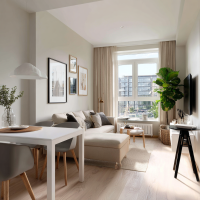
When buyers walk into a home for the first time, they aren’t just evaluating walls, floors, and finishes. Consciously or not, they are asking a much more personal question: Can I see myself living here? Neutral spaces play a powerful role in answering that question, often more effectively than bold design choices or highly personalized interiors.
Neutral design creates emotional breathing room. Soft tones, balanced colours, and simple finishes allow the mind to relax rather than react. When a space isn’t visually demanding, buyers can focus on how the home feels instead of analyzing individual design decisions. This sense of calm helps buyers stay open and curious, rather than distracted or overwhelmed, especially during a showing where many homes may be viewed in a short period of time.
One of the biggest strengths of neutral spaces is their ability to reduce personal bias. Strong colours, distinctive patterns, or themed décor can instantly trigger preferences — or objections. While one buyer may love a dramatic feature wall or bold cabinetry, another may see it as an immediate renovation project. Neutral interiors avoid this divide. They create a shared visual language that feels familiar, approachable, and easy to understand, making the home appealing to a wider range of people.
Neutral spaces also make scale and layout easier to read. When colours and finishes are understated, buyers can more clearly assess room proportions, ceiling height, and flow from one area to another. Nothing competes for attention, so the structure of the home becomes more apparent. This clarity helps buyers imagine how furniture would fit, how rooms could be used, and whether the layout supports their daily routine.
Light interacts especially well with neutral design. Natural light reflects more evenly off soft surfaces, making spaces feel brighter and more open. Even in rooms with limited windows, neutral colours can prevent the space from feeling heavy or closed in. Buyers often interpret this brightness as a sign of comfort and livability, even if they can’t pinpoint exactly why the room feels better.
Another advantage of neutral spaces is flexibility. Buyers today think beyond how a home looks on day one — they consider how it will adapt over time. Neutral interiors feel like a blank canvas, allowing future owners to layer in their own style gradually. Whether tastes shift, family needs change, or rooms take on new purposes, neutral spaces feel ready to evolve without requiring immediate or costly changes.
From a psychological standpoint, neutral design lowers the mental effort required to imagine ownership. Buyers don’t have to mentally “remove” someone else’s personality from the space before adding their own. Instead, the home already feels like a starting point rather than a finished statement. This makes the idea of moving in feel simpler and more achievable.
Ultimately, neutral spaces don’t sell a lifestyle — they make room for one. By stepping back visually, they allow buyers to step forward emotionally. And when people can clearly picture themselves in a home, the connection becomes stronger, more personal, and far more likely to turn into a confident decision.